
The value of craft in the digital age
The Goldsmiths’ Centre is an independent charity founded by the Goldsmiths’ Company, and supported by the Goldsmiths’ Foundation. Our largest single direct investment in the future of our trade and craft, it exists to support the jewellery, silversmithing and allied industries through learning and professional development and by providing workshop space and community to dozens of small businesses within our trade.
For Goldsmiths’ Stories, gemmologist and jewellery specialist Joanna Hardy visits this hive of jewellery-making activity on the edge of Hatton Garden, to find out how four contemporary designers and makers balance traditional hand skills and contemporary technology in a world gone digital. Photography by Tex Bishop.
This story was commissioned by GAIL’s and first published in edition #2 of their printed magazine Companion – a space where the bakery steps away from the day-to-day to explore the ideas, values and ways of working that shape how they do things – and is republished as a Goldsmiths’ Story with their kind permission.
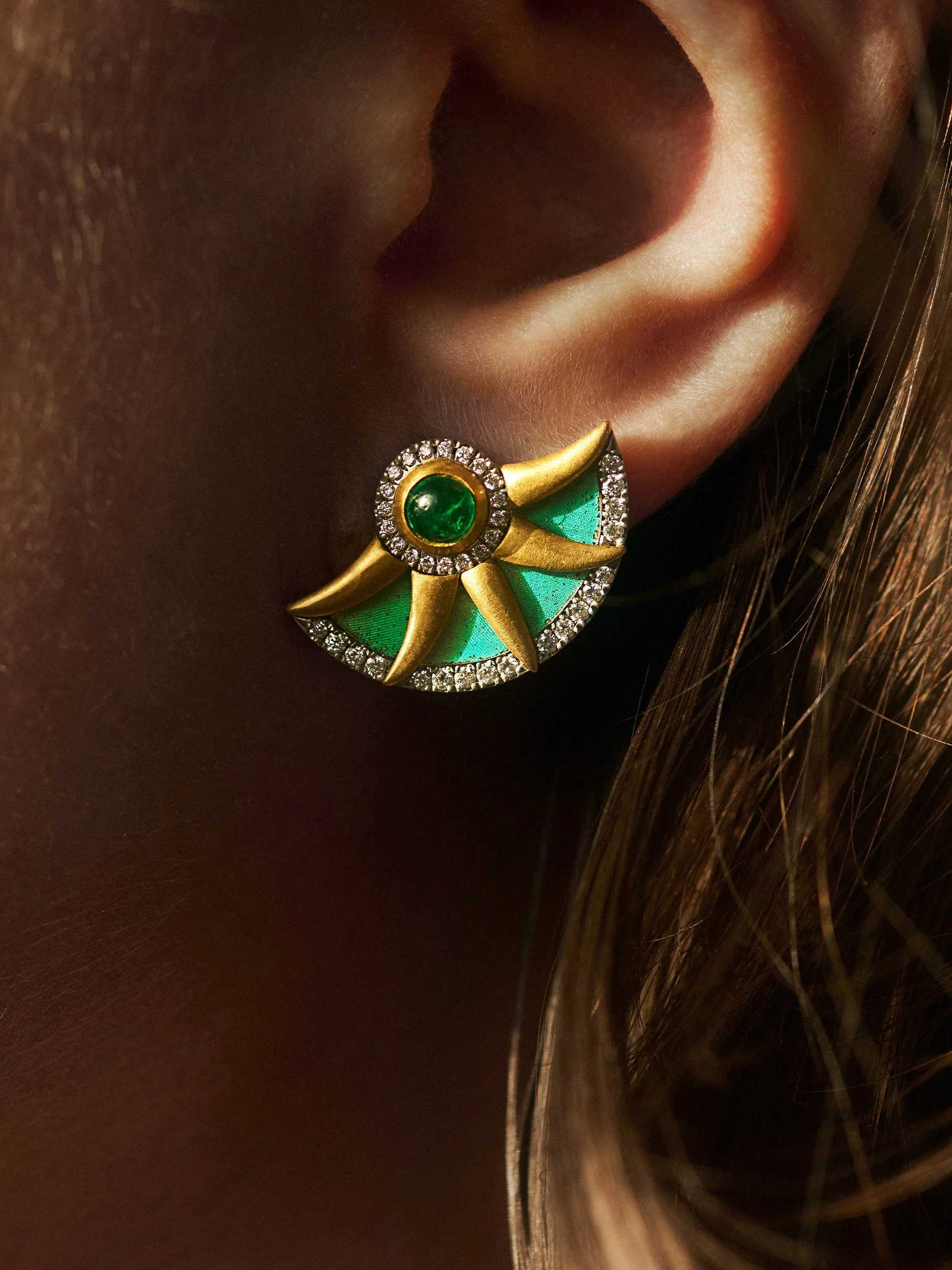
Papilio Blumei Earings by Ben Hawkins. Gold-framed butterfly wings (sustainably sourced) set with diamonds and a Colombian cabochon emerald.
In the four decades that I have worked in the jewellery trade, I have seen production methods change, but I have seen little change in the way we talk about or understand jewellery production. Though we don’t often admit it, much of the jewellery in high-street jewellery shops or on the internet has been mass produced and has likely received little interaction with a craftsperson. Even well-known brands that evoke the timelessness of craftsmanship in their advertising often use automated production. To consider the impact of these changes in production, I posed a question to colleagues from across the jewellery community: what does craft mean to you?
Clustered in a former school building near Farringdon, a stone’s throw from Hatton Garden, the historic jewellery district of London, is a community of more than 130 jewellers, silversmiths and small businesses. The Goldsmiths’ Centre is a hive of creative activity built on the nearly 700-year legacy of the Worshipful Company of Goldsmiths, one of medieval London’s 113 livery companies that were formed to regulate and control various trades. Still today, the Goldsmiths’ Company’s purpose is to monitor and control the standard of gold and silver by assaying (testing) and hallmarking items, a procedure that has been undertaken in the same location since 1327, and to administrate the five-year apprenticeship programme for goldsmithing and silversmithing. Since the Goldsmiths’ Centre opened in 2012, its crafts – steeped in tradition, using tools that have not changed for hundreds of years – has thrived, but they have had to keep pace with the ever-changing landscape of creativity.
Charlotte Dew, Head of Public Programmes at the Centre, is keenly aware of the fine balance in offering courses that embrace modern technology while still teaching the traditional skills of the silversmith and goldsmith. Computer-aided design (CAD) and 3D printing have been entrenched in the training programmes for a number of years now. When the centre’s team first integrated CAD into the programmes, members of the trade were nervous that it would erode craft and destroy creativity. Instead, it has become just another tool in the toolbox. It is not used by every craftsperson as it depends whether the ‘tool’ is relevant to their specialism. This selective approach, Charlotte feels, will be the same response to artificial intelligence.
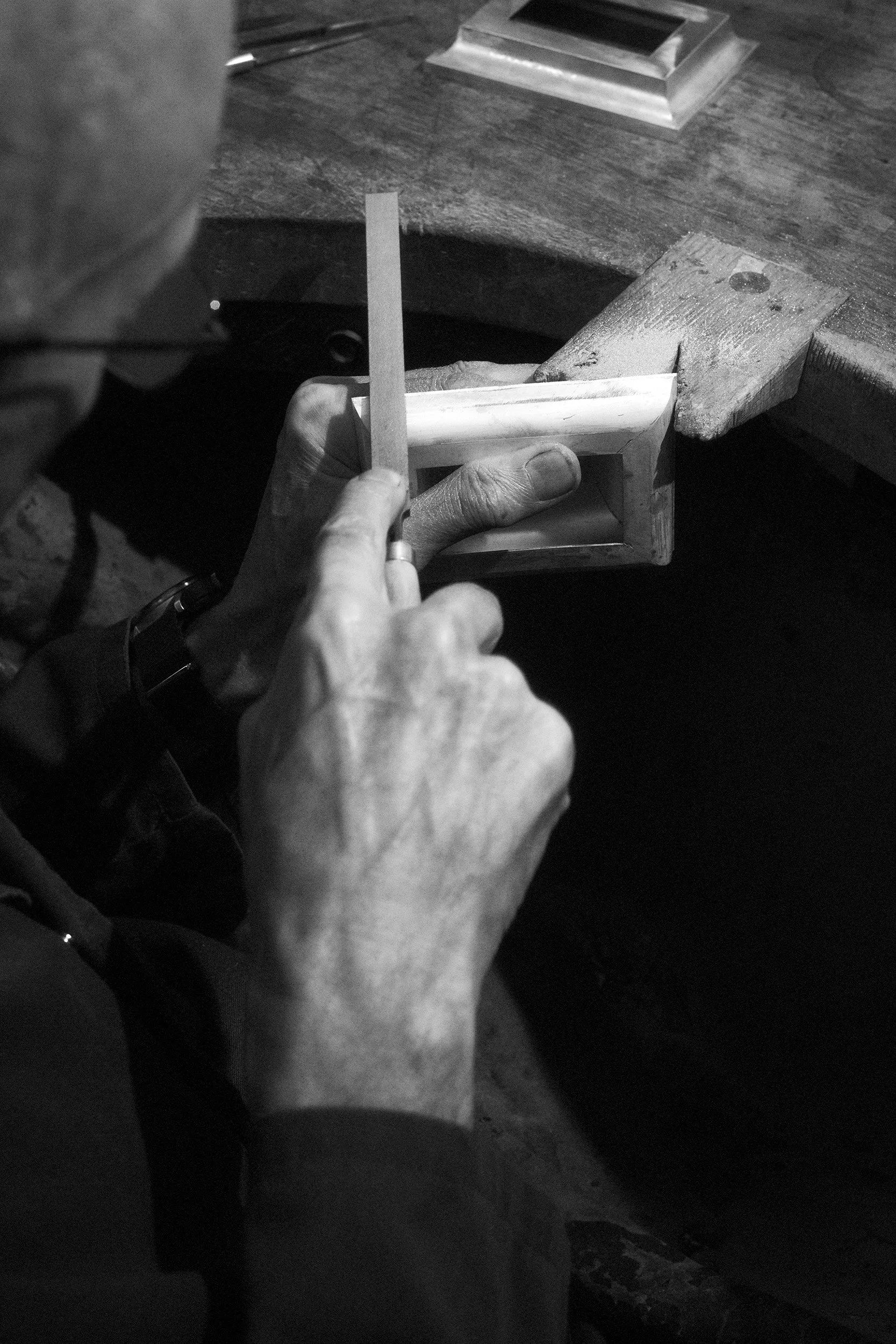
Silversmith’s hands - Clive Burr filing at the bench
Clive Burr is a master silversmith whose workshop is at the Goldsmiths’ Centre. For Clive, there are pivotal areas of his expertise that haven't been taken over by technological changes. A case in point is the spectacularly crafted Coronation Cup of His Majesty King Charles III that Clive and enameller Jane Short made with nine other craftspeople. Clive believes we are a long way off from a machine being able to replace the skills of 11 craftspeople. That would entail learning their processes (including raising a sheet of silver into a vessel, engraving it and enamelling it) and assembling the parts to create one object. He also challenges a machine to add the final ‘wow’ factor: a special combination of originality, personality and soul. Clive believes it is a privilege to make something that is going to be very personal to somebody.
But he agrees with Charlotte that new technology is another tool in the toolbox. He compares it to the gradual move from hand drills to electric drills, then lasers; with each change, processes became quicker, saving valuable time. Yet, crucially, these technological changes haven’t taken over the processes.
Walking down the corridor of Goldsmiths’ Centre, I reach the studio of British/Ghanaian jewellery artist and curator Emefa Cole, who was the first curator of jewellery (diaspora) at the Victoria & Albert Museum. Creativity feeds her soul, she enthuses. She remembers her first experience of working with metal as euphoric. She knew she had found her passion. Having been introduced to the process of lost-wax casting at college, she continued to teach herself and experiment with it. It's a process that has since become her signature.
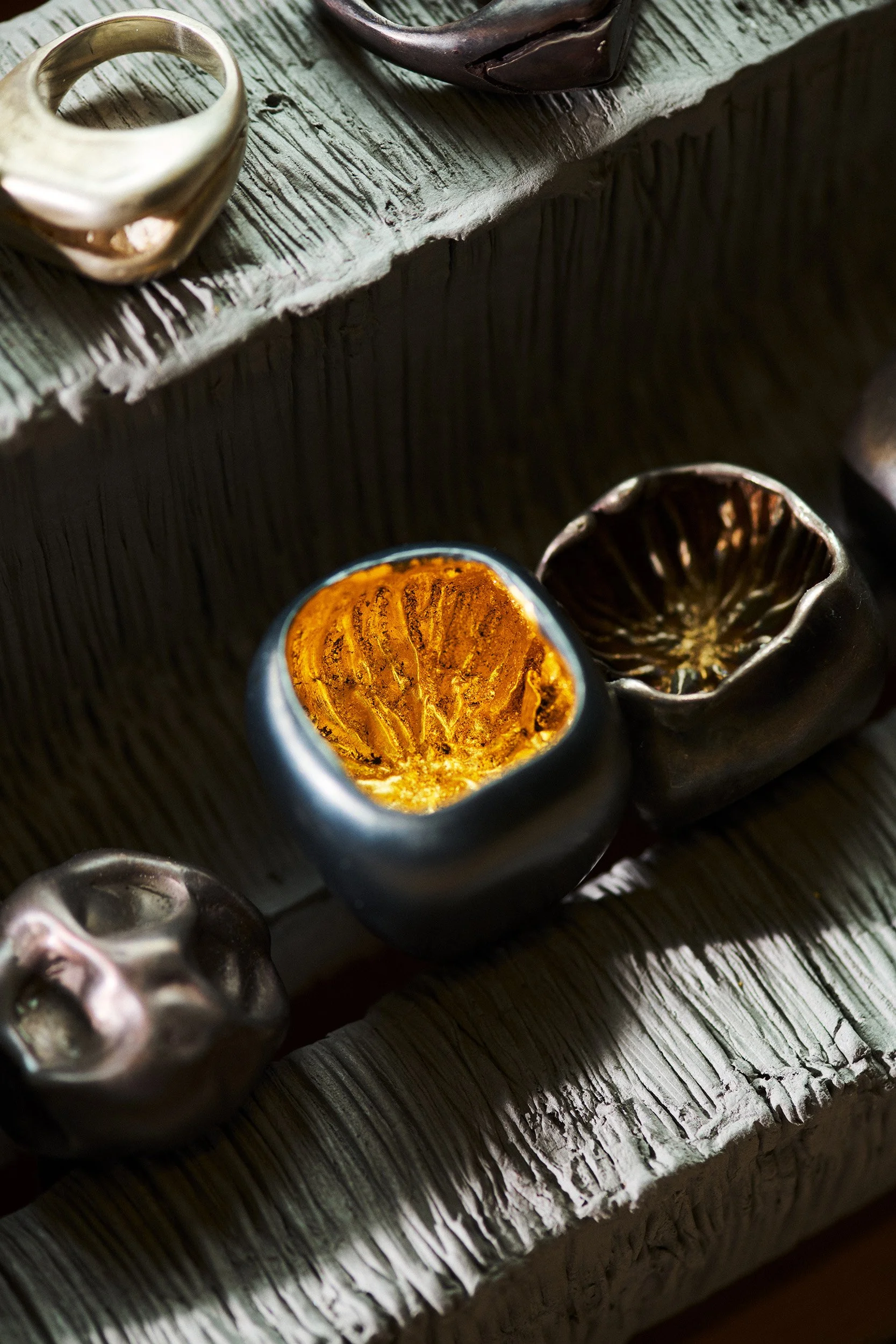
Caldera Ring made by Emefa Cole, lost wax casting in oxidised silver using gold leaf
It takes many years to become a competent jeweller – there are so many different processes to learn before making a piece of jewellery by hand. From concept and design, to making a model, finding the gemstones or materials, possibly alloying gold yourself, mounting, setting, engraving, enamelling, polishing – the list goes on. At every stage, you analyse the process so you end with a product that is infinitely better than what you’d have if you just had a drawing and ran it in a programme to be printed. This making and learning process is at the core of the journey of being a craftsperson.
Emefa reflects on the world of social media that we are all exposed to: she is careful not to get caught up in it, so that her work remains original. It's a pitfall of using AI or other computer-generated platforms – the risk that originality quickly evaporates; but Emefa remains positive ‘AI does not have my brain, and that is what sets me apart from others. If we don’t use our brains, we will become lazy. The brain is a tool that needs to be used, otherwise what are we as humans? I am sure there will be someone who will be able to use AI in an amazing way and be very successful, but that’s not my journey’.
In this traditional craft, knowledge is passed down from master craftspeople to their apprentices. Are new technologies eroding or enhancing this flow? Jeweller Benjamin Hawkins has also made the Goldsmiths’ Centre his base because sharing his skills and opportunities is a big part of his practice, having completed the centre’s nine-month Foundation Programme and been taught by Clive Burr, who is still on hand to consult. In his workshop, Benjamin shows the next generation of Foundation students how to responsibly align digital design and hand skills. Ben turns to CAD for a number of his pieces as it is useful for designing repetitive components, such as chain links; or for casting items where making by hand would take too long and inhibit the price; or for very intricate work in which CAD can eliminate the risk of errors.
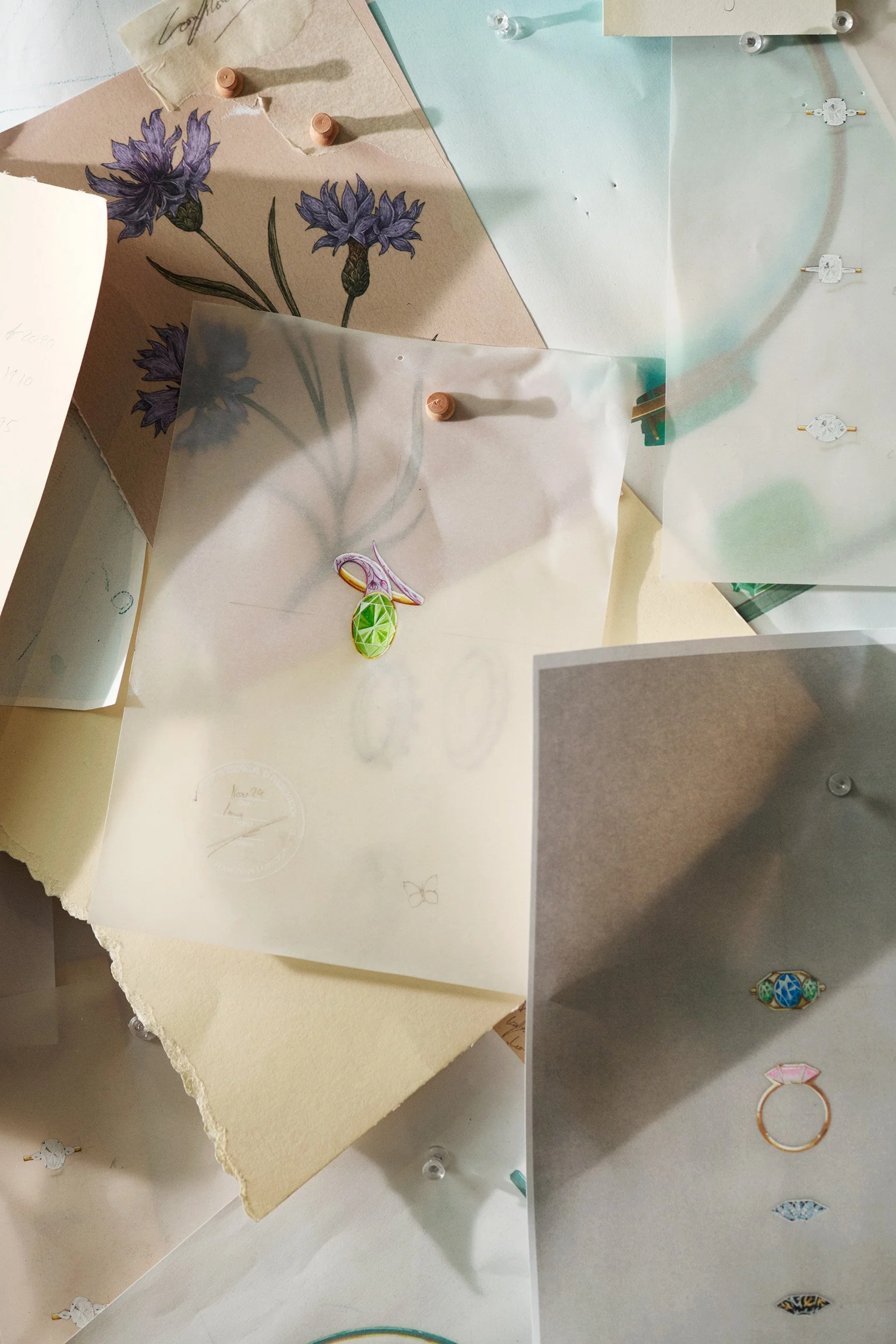
Gouache design paintings for a bespoke ring by the Ben Hawkins team
We have long used machines to undertake mundane jobs. For small businesses in the jewellery trade, turning to newer technology can free someone’s time to spend on more rewarding creative jobs. Crucially, Benjamin employs an in-house CAD designer. He feels that CAD designers, who generally have a graphic design background, gain more of an understanding of the craft when sitting next to the goldsmiths in the workshop. Feeling the metal in their hands and learning how it responds to manipulation only enhances the design process. In an ideal world, a craftsperson would have experience in both making and CAD design, but people with both skill sets are rare. Benjamin believes keeping hand skills alive alongside automated processes will always be important, as every stage can be tweaked and changed, which gives the object life. When everyone uses the same software, you need people to break that repetition.
Working at the cutting edge of modern technology, young jeweller Xinyi Chen has a different view of her craft: her mother worked in a computer factory. Xinyi remembers being given an old telephone, which she took apart. All the components reminded her of the various colourful ‘Californian gemstone computer parts’ her mother had worked with. It struck her to make jewellery from them. Now based in Liverpool, Xinyi likes to pick one or two traditional techniques to combine with modern design language to see if she can push the boundaries of hand skills. Her award-winning jewellery looks like it's from a computer but is assembled by hand. Xinyi is not afraid of AI – she says that jewellery needs to be touched, worn and interacted with. She is confident that her jewellery will not feel like anyone else’s. Instead, Xinyi embraces what AI can do to help tell the story of her work. Recently, she has explored advertising her jewellery using a metahuman, a digital character, but she still solely only physical rather than digital jewellery.
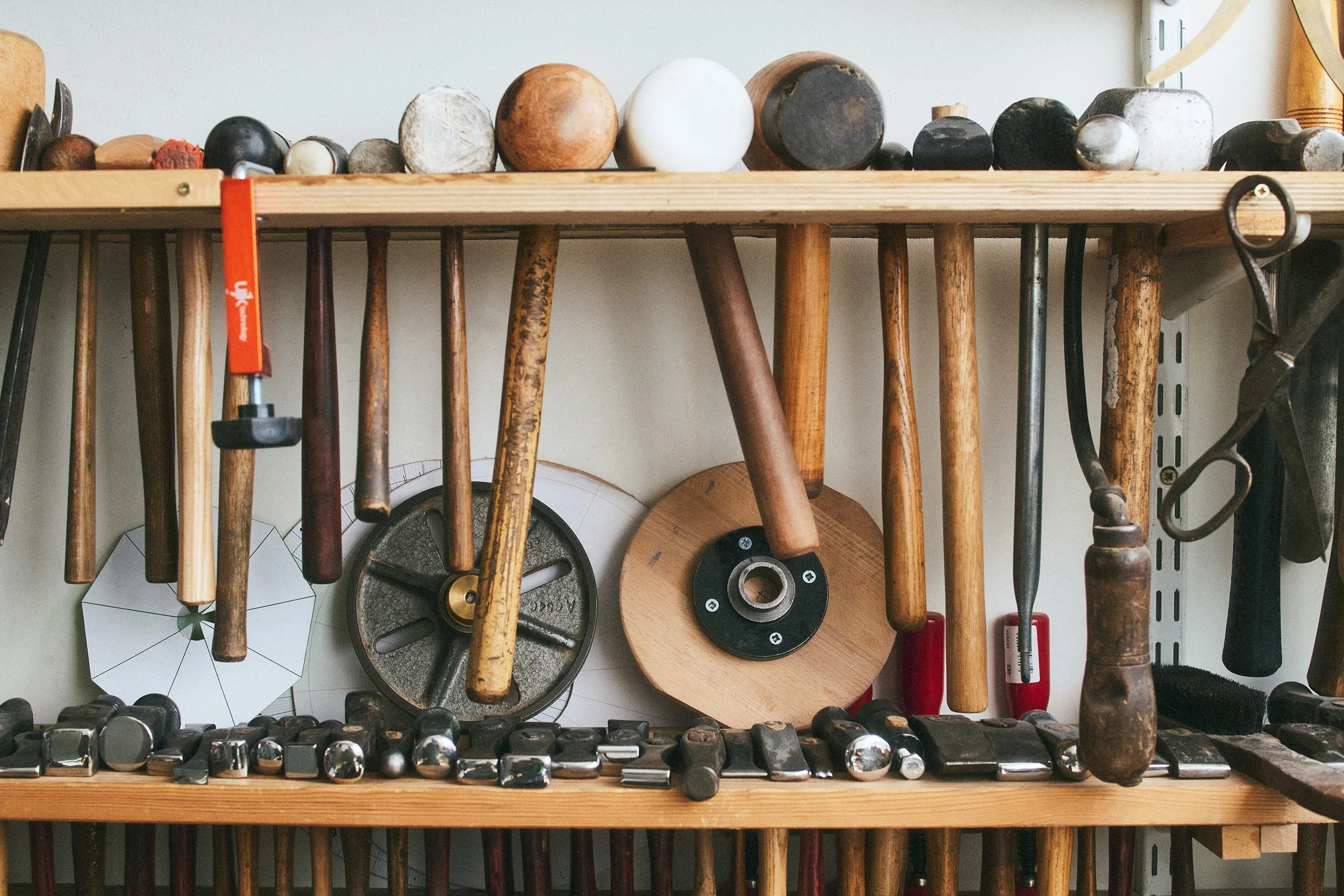
A selection of mallets and planishing hammers
The craftspeople I have spoken to have allayed my fears of the advancement of misused technology and its impact on traditional skills and our idea of ‘craft’. New technology is ever-present in the trade – and rightly so – and, when used imaginatively, each ‘next big thing’ becomes another very useful addition to that toolbox. Utilising AI sophisticatedly, for instance, will become second nature to the younger generation. As Charlotte Dew reassured me, any tool is only as good as the brain or the hand that is using it. At the end of the day, it is about being transparent and engaging storytellers, so that we enthusiastically educate clients and explain to them their options. I have always advocated that it is not what the jewel is made from that is important. Instead, it is the craftsmanship executed with passion that can turn any material into an item of beauty. Ultimately, a craftsperson’s passion is the secret ingredient to success.
This story was commissioned by GAIL’s and first published in edition #2 of their printed magazine Companion – a space where the bakery steps away from the day-to-day to explore the ideas, values and ways of working that shape how they do things – and is republished as a Goldsmiths’ Story with their kind permission. Edited by Amanda Schiff and designed by Carol Montpart Studio, Companion #2 brings together a wide range of voices and forms: essays, reportage, interviews, poetry, photography and recipes centred around the theme of craft. Companion #2 is available to purchase online and in all GAIL’s bakeries today.