
Alistair McCallum
Dr Dora Thornton and Rebecca de Quin celebrate the life and work of Alistair McCallum, 1953-2026. Alistair was one of our most distinguished British silversmiths. His sophisticated award-winning work is widely represented in public and private collections in the UK, Europe and Australia. He will also be remembered as a highly influential teacher and mentor to several generations of makers.
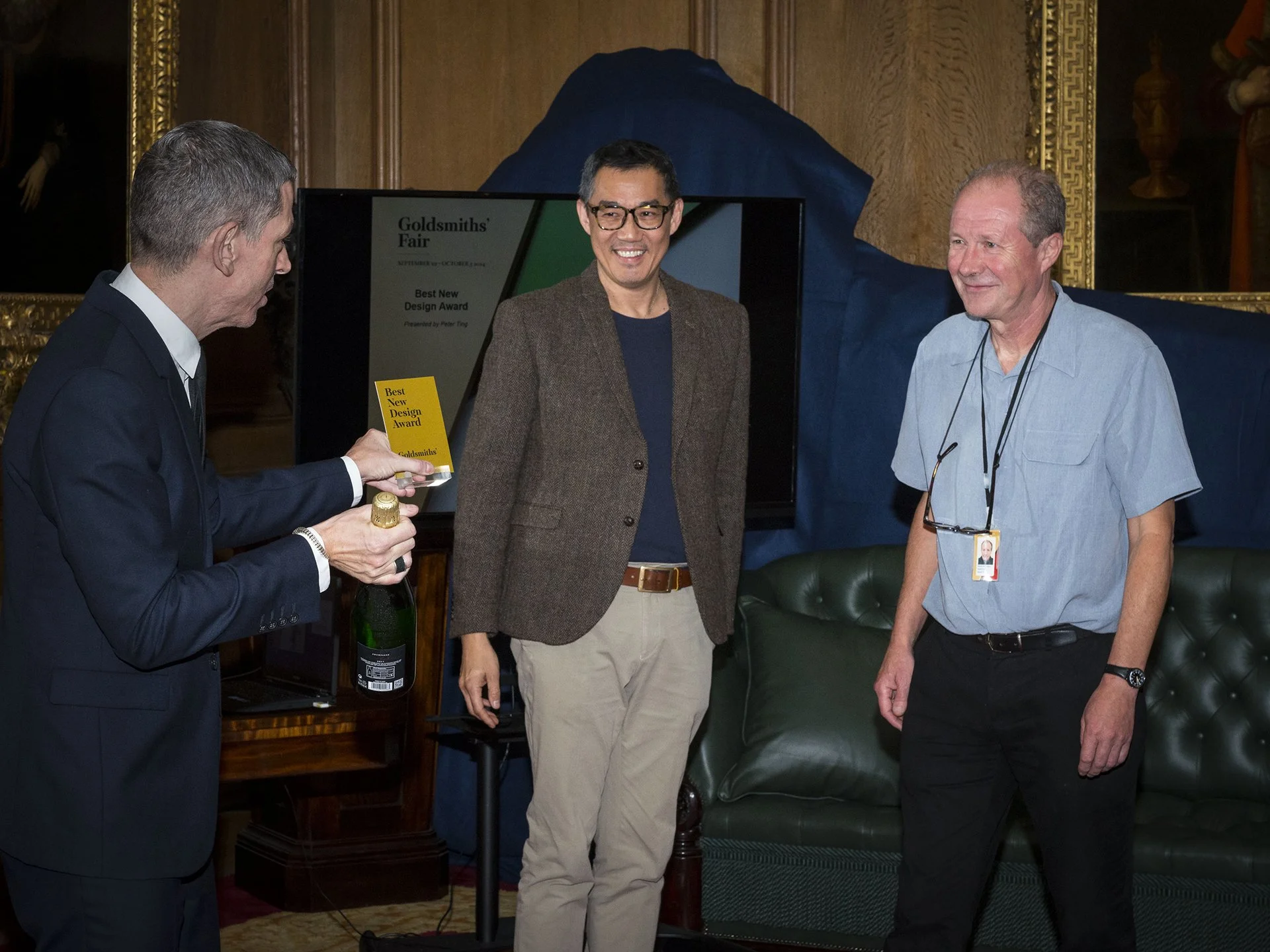
Alistair receiving the Best New Design Award at Goldsmiths’ Fair 2014
A tribute by Dr Dora Thornton, Head Curator of the Goldsmiths’ Company Collection
Alistair was especially known for his unique, innovative pieces in mixed metal, using his own version of the 17th century Japanese technique of mokume gane [‘eye of the wood metal’]. Born in Cleveland in 1953, he studied at Teeside College of Art; Loughborough College of Art and Design; and then undertook a postgraduate course with Gerald Benney at the Royal College of Art (RCA), which he completed in 1978. In 1979 he shared a workshop in Rotherhithe with two other RCA graduates, silversmith and art enameller Jane Short and silversmith Clive Burr, then moved with them to Old Sreet, before setting up in his own basement in Lewisham. He started teaching at Camberwell in 1979, where he stayed until 1999 as just one of his many teaching posts. He was always modest and approachable and remained helpful and supportive to young silversmiths until the end. Clive Burr recalls: “He was one of my oldest friends having met at art college many, many years ago. He will be greatly missed by all who knew him. He had taught and mentored a great number of the younger silversmiths that are practicing today.”
Discovering as a boy that he was dyslexic, he turned to making things in school metalwork classes, and quickly made metal his chosen language of expression. It was through playing with metal in the 1970s that he stumbled on the Japanese technique of mokume gane quite by chance. He had soldered together layers of different metals to make a laminate which he then passed through a rolling machine to make sheet. When he filed into the surface of the sheet the most delicate patterns made by contrasting colours of the metals were revealed. “I thought it was amazing.” He continued to experiment with silver, copper and gilding metal, supported by John Bartholomew, as he found his own way into the technique: “I wished to innovate rather than emulate traditional Japanese work.” The Japanese tended to fuse the metals together in multiple layers. Although he made exquisite pieces using this technique he generally preferred to solder four to six layers for much of his work, although he could use up to 128 layers for a piece. The rolling mill used to make the sheet restricts the size of mokume gane work, so he made large-scale vessels from two seamed elements, hiding the joins by filing a vertical pattern which produces a faceted surface. A superb example of this technique is the vase in the Goldsmiths’ Company Collection, made from sheet comprising 6 layers of copper and gilding metal backed with silver. Other pieces in the Collection show his remarkable eye for pattern, which, in his hands, became a form of drawing in metal. They also demonstrate his understanding of form: “I strongly believe that the technique is only part of the design process and that the relationship of function, pattern and form needs to be understood and work together to achieve a successful piece.”
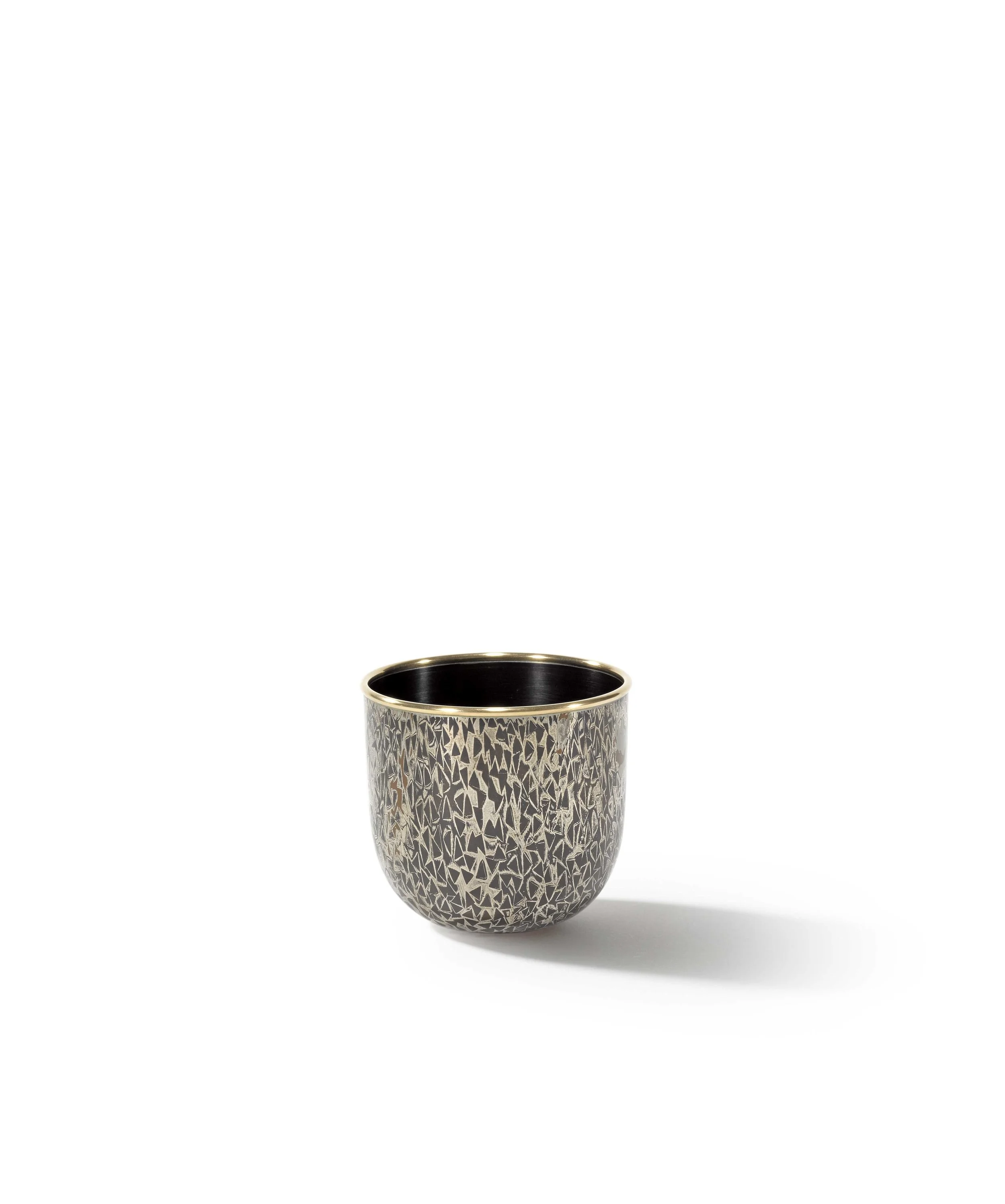
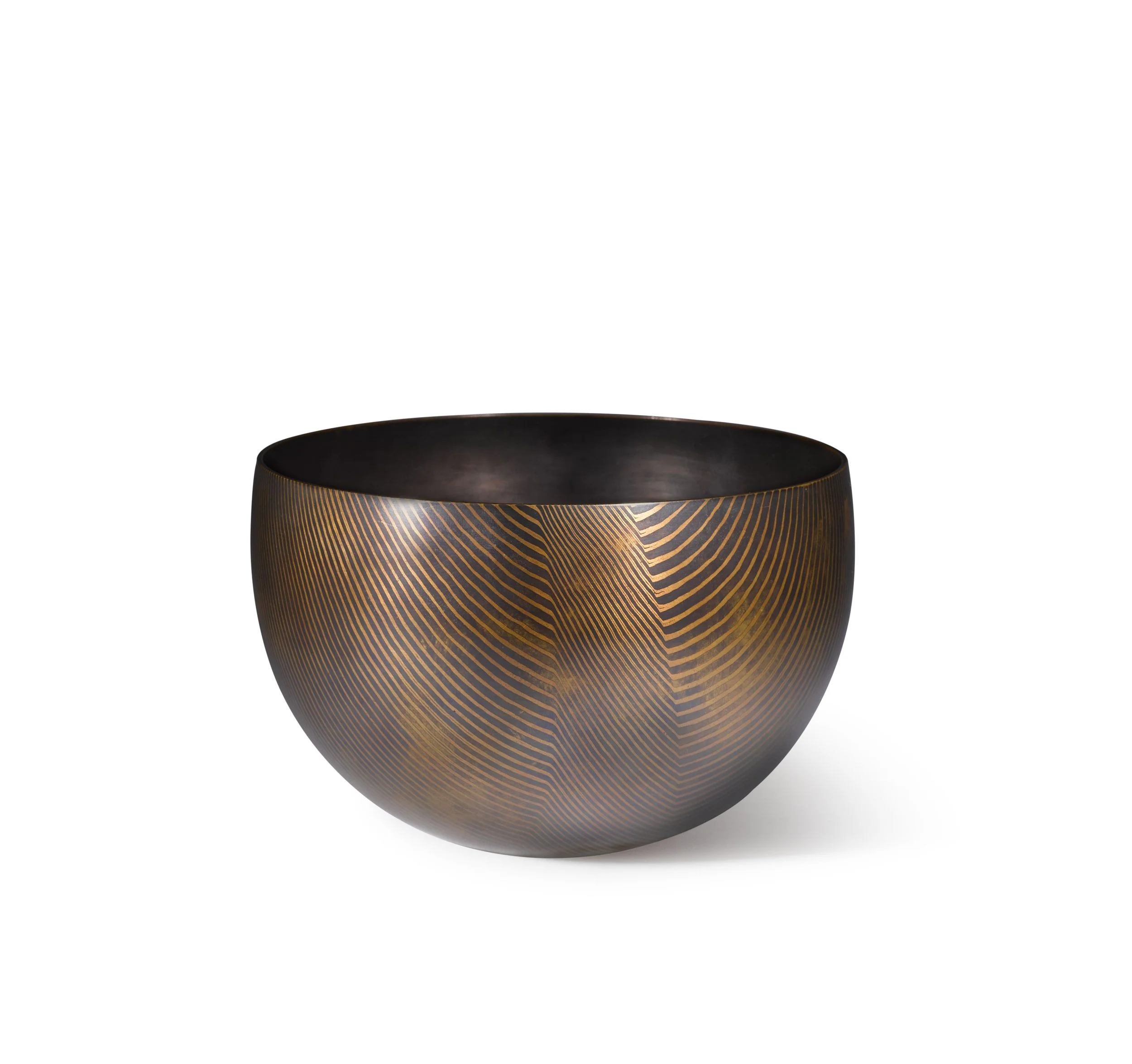
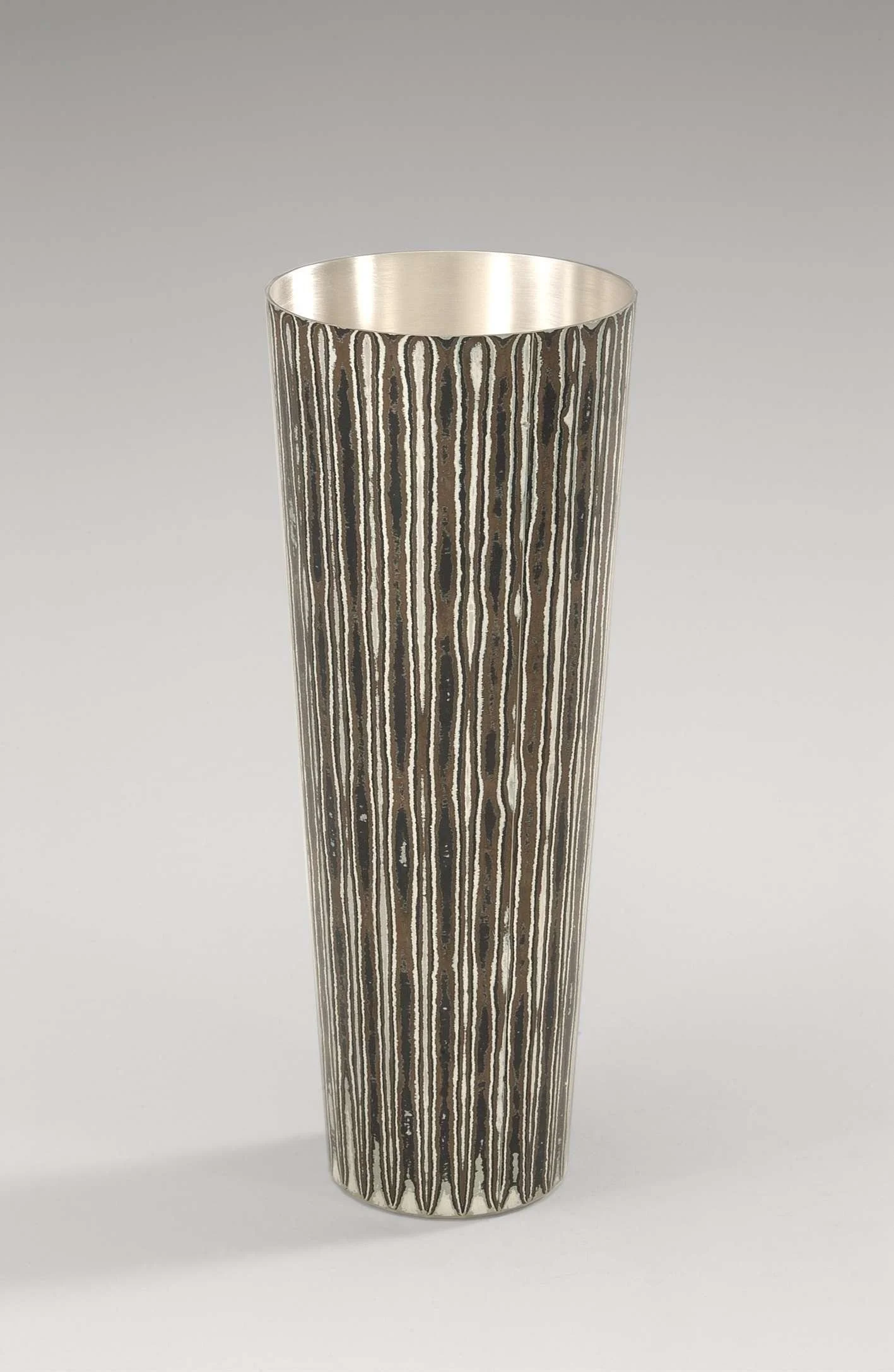
From the Goldsmiths’ Company Collection: Beaker, 1996, silver, copper, gilding metal, Alistair McCallum. Bowl, 1983, copper, gilding metal, Alistair McCallum and David Pledge. Vase, 2002, silver, copper, gilding metal, Alistair McCallum.
His work was widely exhibited and sold - including at over 28 Goldsmiths’ Fairs. The Goldsmiths’ Company is fortunate to have acquired 8 of his pieces dating from 1980 to 2014, several of them purchased from the Fair.
A tribute by one of his former students at Middlesex Polytechnic, Rebecca de Quin:
“I was fortunate to have Alistair as my tutor during the final two years of my BA at Middlesex Polytechnic in the late 1980s. At that time, he was producing exquisitely finished small objects, combining silver with gilding metal. His commitment to working with non-precious metals alongside silver encouraged both me and my fellow students to explore our material beyond the traditional boundaries of silversmithing and metalwork.
Alistair was a kind and patient teacher, whose feedback was always thoughtful and well judged. I was particularly drawn to his use of processes such as presswork and spinning; his enthusiasm and generosity in sharing knowledge played a significant part in shaping my own interests and direction. It was through this growing sense of purpose that I went on to MA study at the Royal College of Art, following in his footsteps.
His patient and generous approach to teaching later influenced my own practice as an educator. He was an attentive listener, and his example made clear that good teaching is as much about listening and offering a supportive sounding board as it is about giving advice and sharing knowledge.
In later years, we served together on the committee of Contemporary British Silversmiths, where I continued to value his measured and thoughtful contributions. He would often sit quietly through much of a discussion, only to speak at just the right moment, offering a few well-chosen words that would bring clarity and help settle the matter.
I particularly enjoyed the opportunity, some twenty years ago, to write about his work for Goldsmiths’ Review. Spending time with him as he described the technical intricacies of mokume-gane brought home both the distinctiveness of his approach and the extent to which he had made the technique his own. It only deepened my admiration for his work. Some years before that, we began a three-way collaborative project with a colleague of his from Camberwell School of Art. I remember the meetings in his workshop as a lively and stimulating, full of shared ideas and possibilities for making. On one occasion I arrived with my baby daughter in a baby carrier; I recall, too, the warmth of those moments—introductions to his own daughter, and time spent together with Alistair and Jude. It was a disappointment when funding for the project fell through and we were unable to continue, and I have often wished I had found a way to sustain it.
It was a sadness when Alistair could no longer continue his making, though he seemed to adapt to that change with characteristic resilience. Whenever we spoke, he remained as warm, positive and engaged as ever. I was always comforted by the affection with which he spoke of his family, and by his stories of the friends he met regularly at the pub, whose company clearly meant a great deal to him.
I remain deeply grateful to Alistair for his long-standing support and friendship, and for the lasting influence he has had on my creative thinking and on my development as both a practitioner and a teacher.”