
“Everybody’s got their own special place that means something, haven’t they? You can tell a full life story through a map in a really abstract way.” The Goldsmiths’ Company is proud to support We Are Makers in the commissioning of this story with map artist and jeweller Holly Clifford. Speaking to Holly at her Sheffield studio, she detailed how her work has grown in scale, the skills behind it and the ecosystem of craft relationships it represents.
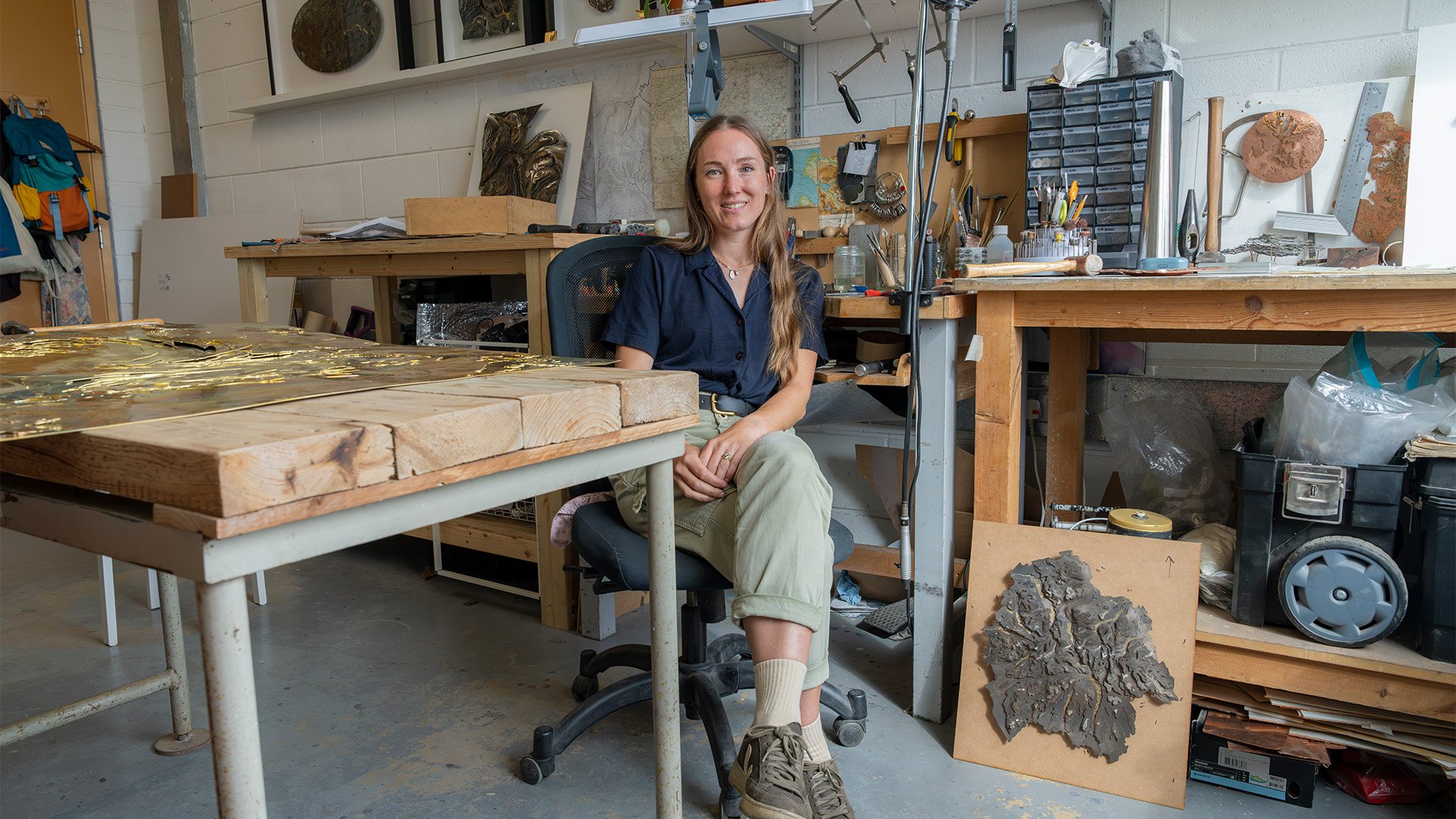
“Everybody’s got their own special place that means something, haven’t they?” For Holly Clifford, maps have become a way of capturing those places. Using the contour lines of a landscape, she builds them up in layers of metal, creating pieces that can hang on a wall or be worn on the body.
When We Are Makers first spoke to Holly, back in 2023, she told them how her career had begun in a shed in her parents’ garden, making the art jewellery that had grown out of her graduate collection.
“No proper equipment,” she remembers. “I had my little travel jewellery kit from uni.” For a while, it worked. But Holly began to realise that staying somewhere comfortable might also be holding her back.“I felt like I was getting to the point at home where it was so comfortable that, if I didn’t push myself out right then, I was running the risk of staying there forever. I wanted to grow, and I knew I couldn’t really from the shed.”
That push eventually brought Holly to Yorkshire Artspace, a studio community for artists and makers in Sheffield. Her map work was developing alongside her art jewellery, but today the maps make up almost all of her work. Her earlier art jewellery has gradually given way to pieces that carry the same contour lines as the maps, bringing her jewellery and her interest in place together.
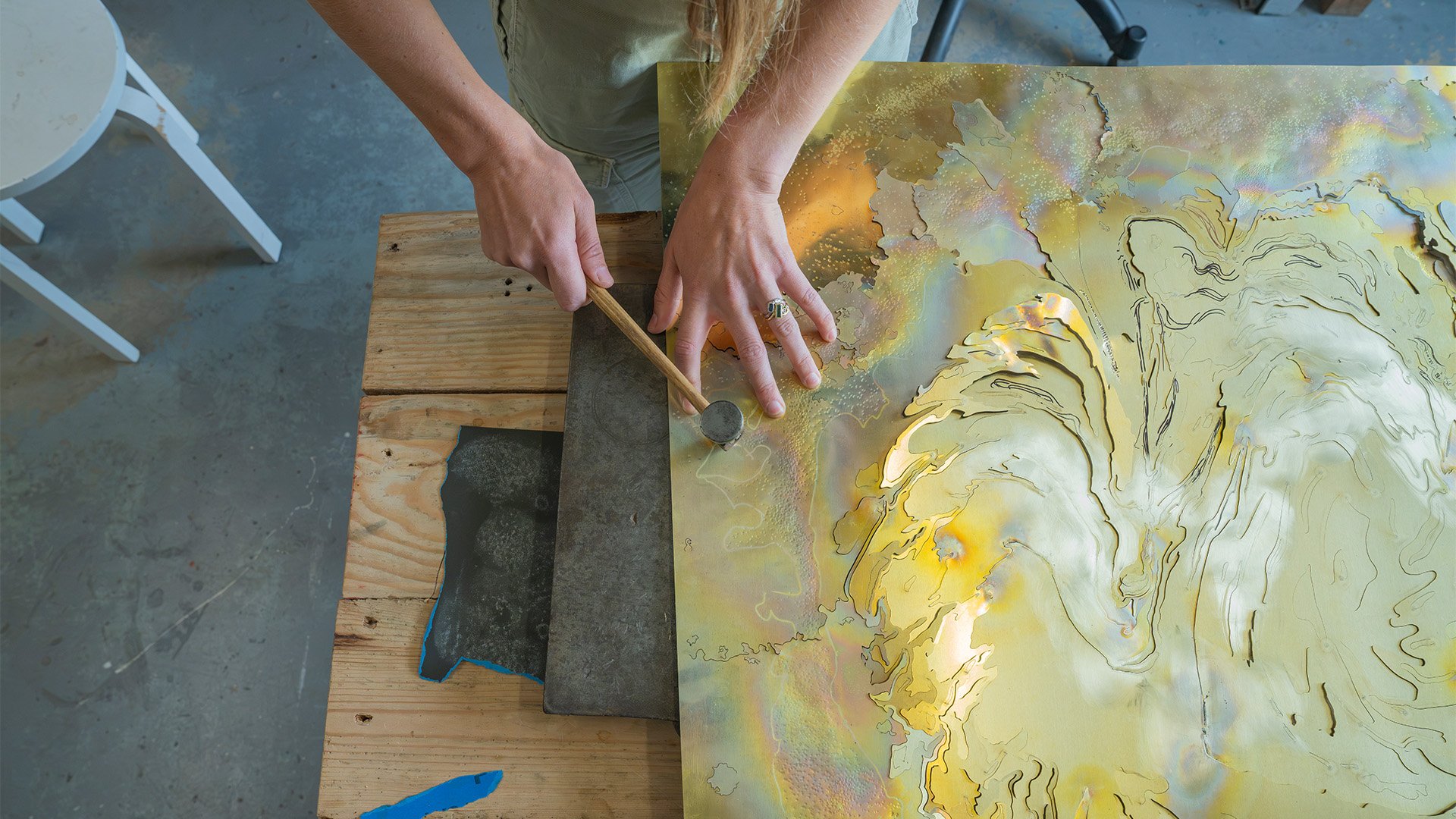
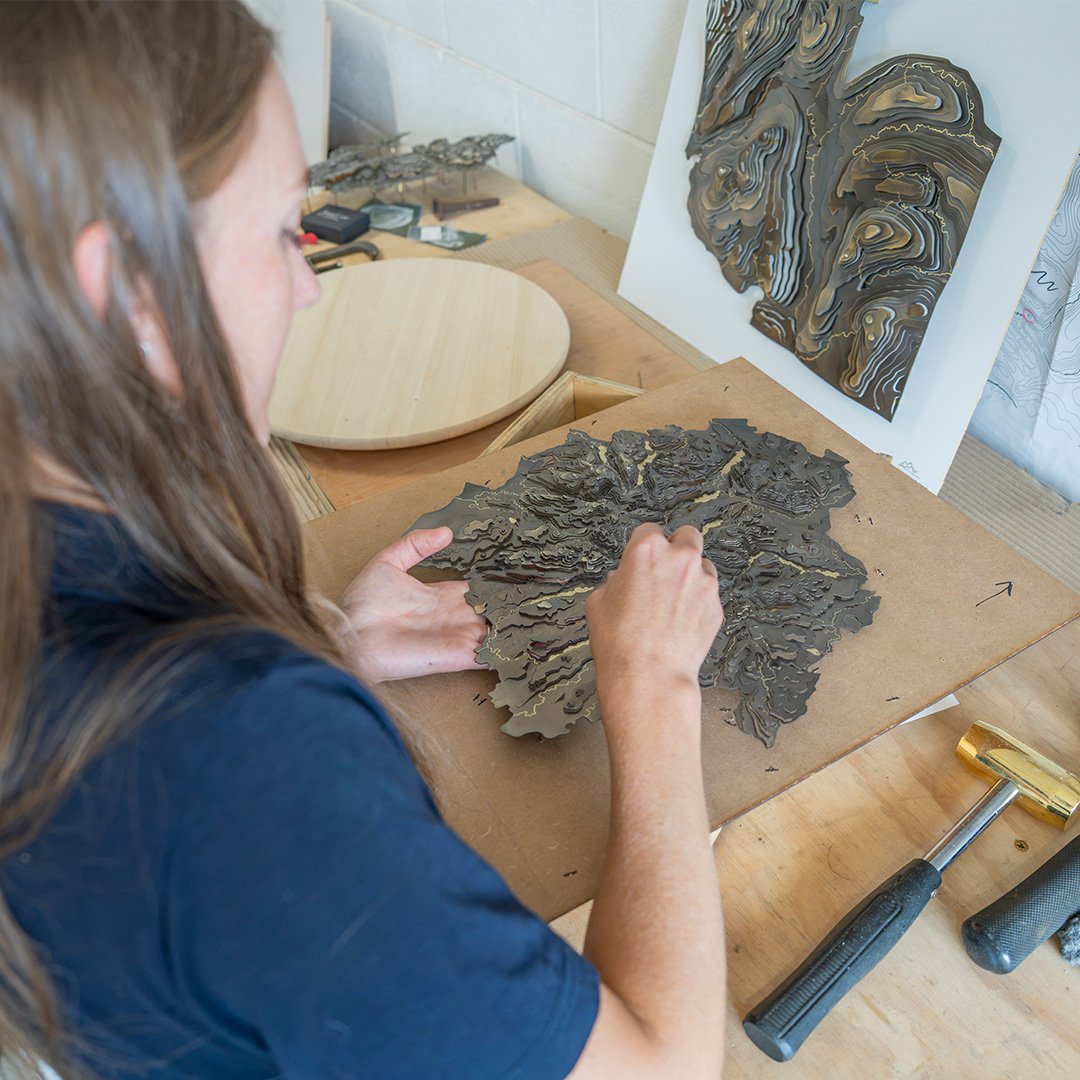
In the centre of her bright, airy studio is perhaps the clearest example of how far that work has come: the beginnings of a large map, made in brass, of Mars’ north polar cap – the piece that now graces the cover of this edition.
It’s a collaboration with Dr Frances Butcher, a planetary scientist and glacial geomorphologist researching the history of glaciation on Mars and Earth, for the University of Sheffield’s Festival of the Mind. Holly is creating the polar landscape in what has become her signature style, showing the layers of ice that have built up there, surrounded by sand dunes. As Holly puts it, the aim is to “bring her research to life”.
Making things visible
Holly’s relationship with contour maps took time to find its shape. She first explored contour lines during her art foundation year, while thinking about landscape, our connection with home and what she calls the “draw to special places”. For Holly, that meant “the hills around home”, which became the subject of her first contour-map piece. Afterwards, she put the idea “on the back shelf”, returning to it years later.
When Holly graduated from Birmingham School of Jewellery, it was her art jewellery – colourful pieces made using eco-resin and paint – that offered the clearer route into making a living. Developed from her graduate collection, she could see how to turn it into a business: make a collection, take it to shows and approach galleries. The map jewellery was there too, in the background, with commissions coming slowly through word of mouth.
Through a conversation with a ceramicist at a show, she heard about the Starter Studio programme at Yorkshire Artspace in Sheffield, which offered emerging silversmiths access to a shared workshop, equipment and technical support.
“Coming to Sheffield opened my eyes more to larger scale pieces.”
The move gave Holly access to equipment she simply hadn’t had in the shed, but just as importantly, to people. As part of the programme, a different technician came into the workshop each week. One was silversmith Bob Lamb, who continued working into his 80s before retiring and moving out last year. “We invite him to visit us every so often,” Holly says.
Being part of the programme brought opportunities to take on commissions and work at a larger scale. For the Precious Little Gems commission, Holly created a silver cruet set with a map of Sheffield as its lid. In 2024, it was gifted to the Company of Cutlers by the then Master Cutler, Charles Turner.
Holly began to find her way into Sheffield’s metalworking trade. More used to Birmingham’s Jewellery Quarter, she found Sheffield’s industry less immediately visible. “It’s a little bit more hidden, but still there, just about, under the surface.”
For this commission, the round box had warped during heating and Holly needed help getting it flat again. She called Bob, who knew exactly where to go: “We need to go see Tony, the hammer man.”
They found Tony near Bramall Lane, where a handful of Sheffield’s ‘little mesters’ (independent, self-employed master craftsmen who specialised in the city's famous cutlery, tool-making and metalworking industries) could still be found, through a “big rickety archway”, past broken-down cars in the courtyard and up a set of stairs that were “falling apart”. His specialist skill was, in Holly’s words, making things “beautifully flat” with different hammers. Tony worked Holly’s warped silver back into shape, before the piece moved on to different people for buffing and polishing. It's a specialisation that’s becoming harder to sustain. “I guess people try and take on more of those niche jobs in one go, don’t they?” says Holly. “Because it’s just not feasible anymore to just specialise in one thing,” though she knows she’d happily lose herself in just one of these skills. “I could see myself being purely an engraver perhaps, or chasing,” she says.
The skill in the community
Experience has shown her the value of learning across different parts of the trade. “If you go off and learn different parts of the trade and bring it all together, it’s much easier for you to understand how to make the final product you’re dreaming up, even if you don’t do all of it yourself.”
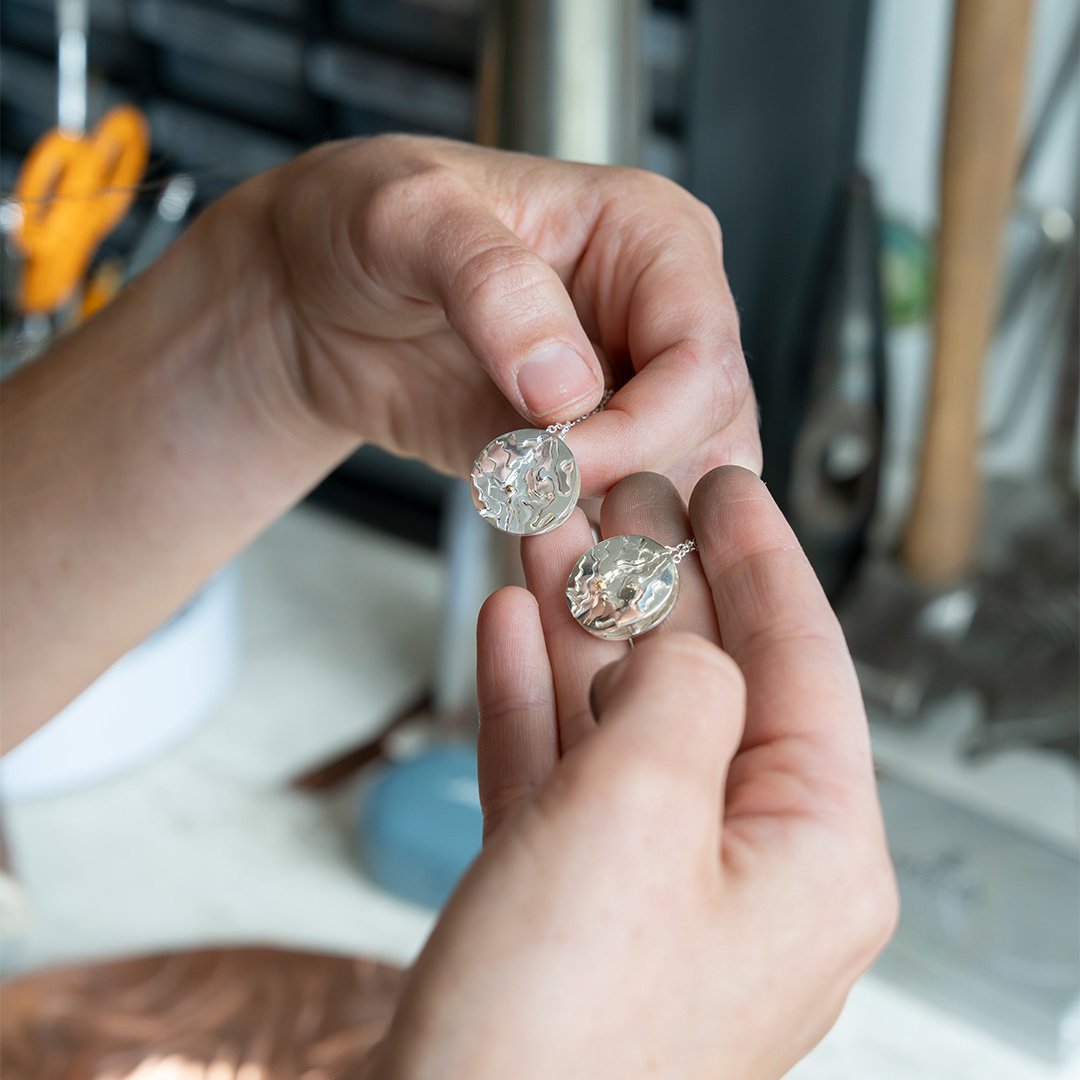
Engraving is a good example. Holly was drawn to the skill, but learning it also gave her a way to solve a problem within her own work. Her contour maps were inherently three-dimensional, built up in layers, and her jewellery had followed much the same approach. Engraving gave her a way to take those same lines onto flatter, more wearable pieces.
“Learning engraving was how I translated the contoured idea from 3D into 2D,” she says. “Obviously, it’s a very different look, but it still has the same message, same meaning.”
Learning how to do it began, again, with another maker. Japanese silversmith Shinta Nakajima who is also based at Yorkshire Artspace, and sometimes uses a Japanese style of hammer-and-chisel engraving in his own work. “I made him cake and he taught me engraving,” Holly laughs.
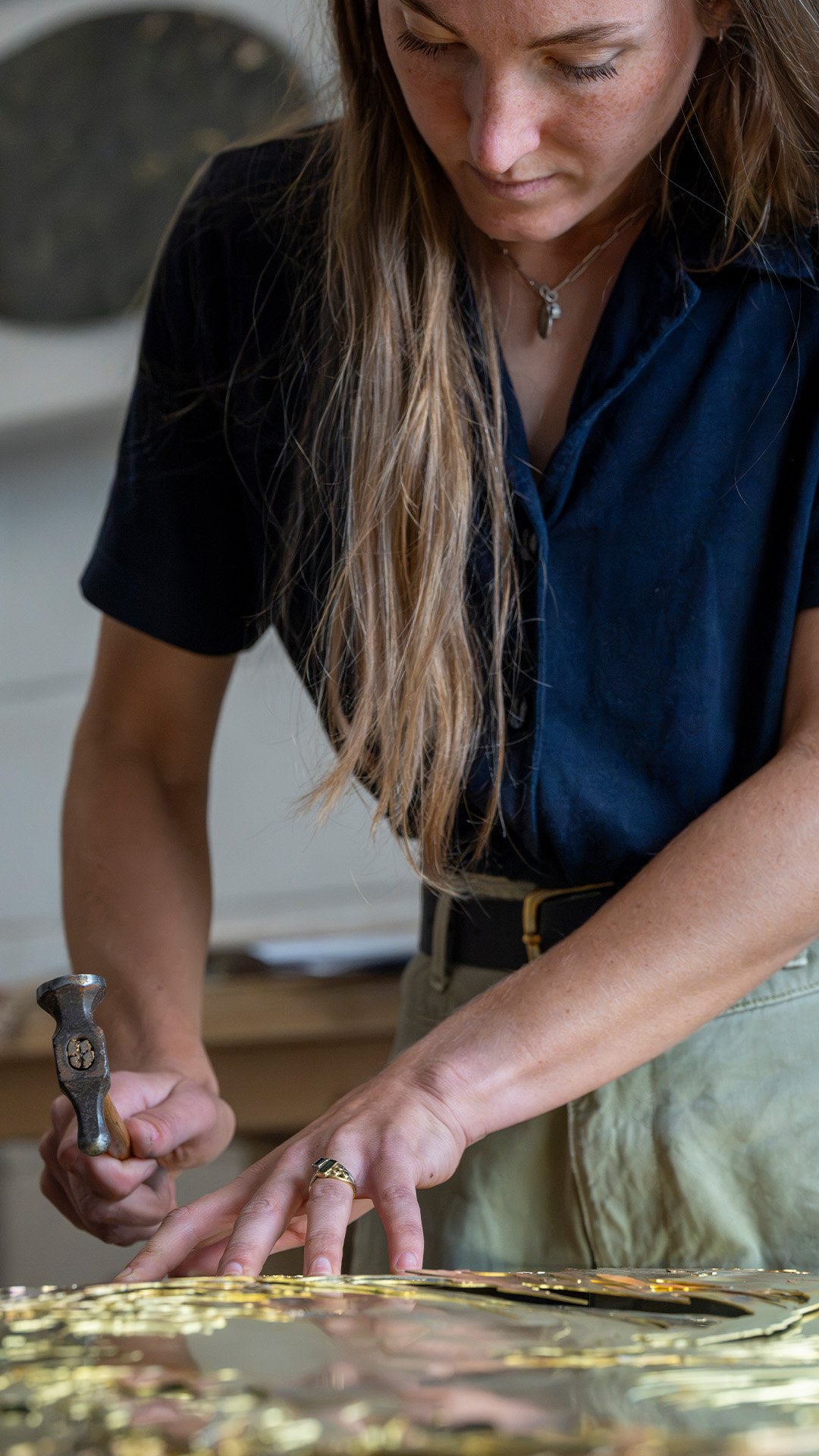
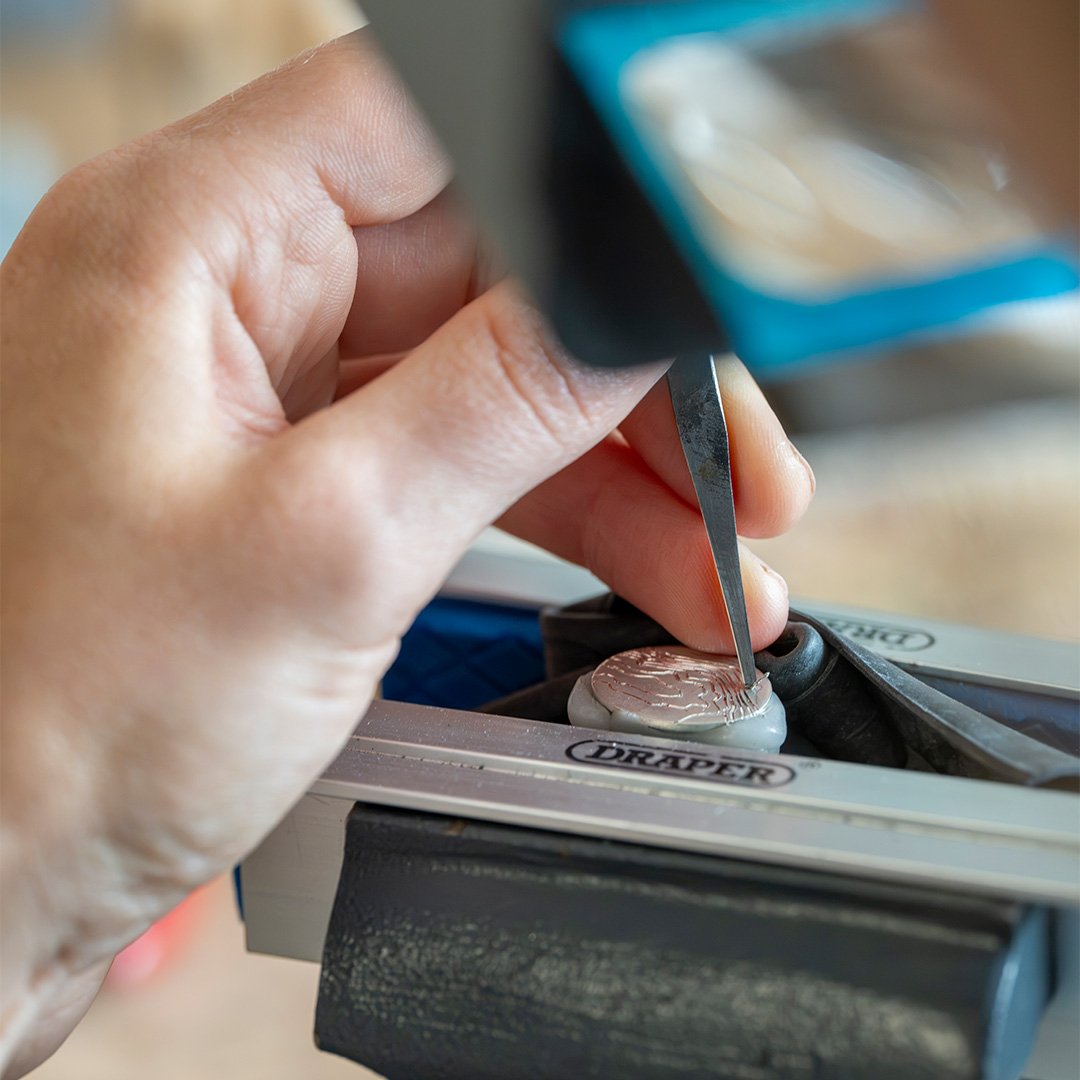
Having Shinta nearby meant Holly could spend time learning from him, not only how to engrave, but how to make the chisels themselves. “That’s one of the hardest things about getting into engraving. You can’t just buy the tools ready-made.” She’d tried learning aspects of toolmaking online, but found getting the angles right difficult without someone there to show her. With Shinta, the technique clicked. Rather than pushing a graver through the metal by hand, she could work gradually with a hammer and chisel, “tap, tap, tapping” her way along the surface.
Another of those relationships was with silversmith Brett Payne, whose workshop was in the same building. Holly had first met Brett through the Starter Studio programme, where he was one of the makers brought in to mentor the group. He later gave Holly a chasing hammer he no longer needed, and remained someone she could turn to for help. “He’s always had an open-door policy,” Holly says. If she was struggling with something, she could knock on Brett’s door and ask.
Through Brett she became aware of the South House Silver Workshop Trust, which he set up with silversmiths Rod Kelly and Chris Perry. Last year, an opportunity through the Trust took Holly to Shetland for a month to work alongside Rod, learning chasing, repoussé and engraving.
Rod’s work often uses chasing and engraving to tell stories in silver, and it was that ability to build a narrative into the surface of the metal that interested Holly. While she was there, she began working on a piece of her own, chasing contour lines into metal and bringing the language of her maps into another process.
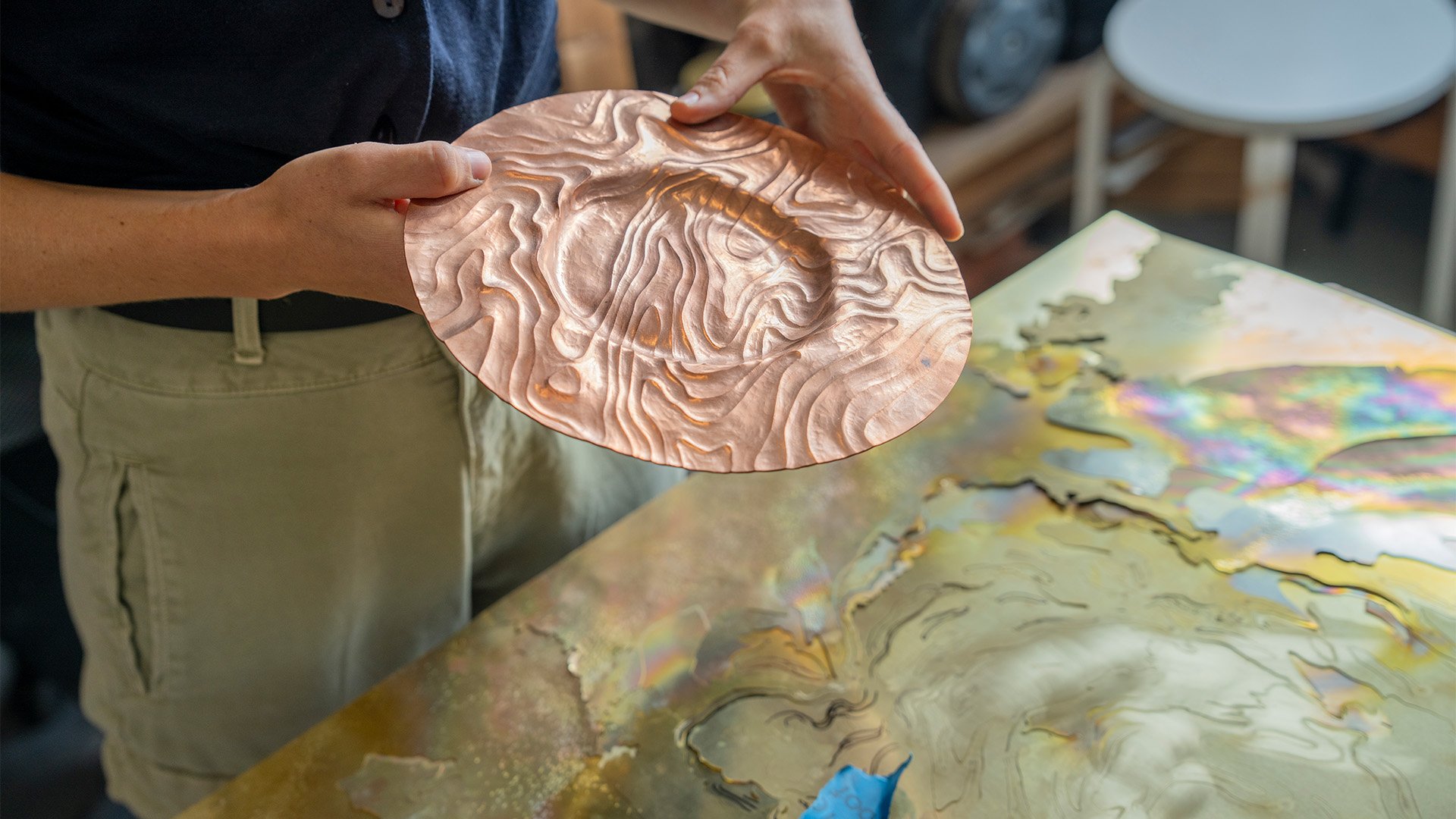
But learning an old technique also introduced Holly to a much more practical problem: the equipment needed to practise it is becoming increasingly difficult to find. Chasing and repoussé requires the metal to be supported in pitch while it’s worked, traditionally held in a heavy cast-iron pitch bowl. “You can’t buy them anymore,” Holly says. Instead, people watch eBay, wait for workshops to close or tools to come up when another maker retires.
Rod had stockpiled pitch when the company that made the type he used stopped producing it. Her solution was waiting outside his workshop.
“He had all these ends of propane tanks that had been cut off,” she remembers. Filled with pitch, the curved steel ends could do the same job as a purpose-made bowl. She brought some home from Shetland, eventually having them shipped back to Sheffield.
Scaling up
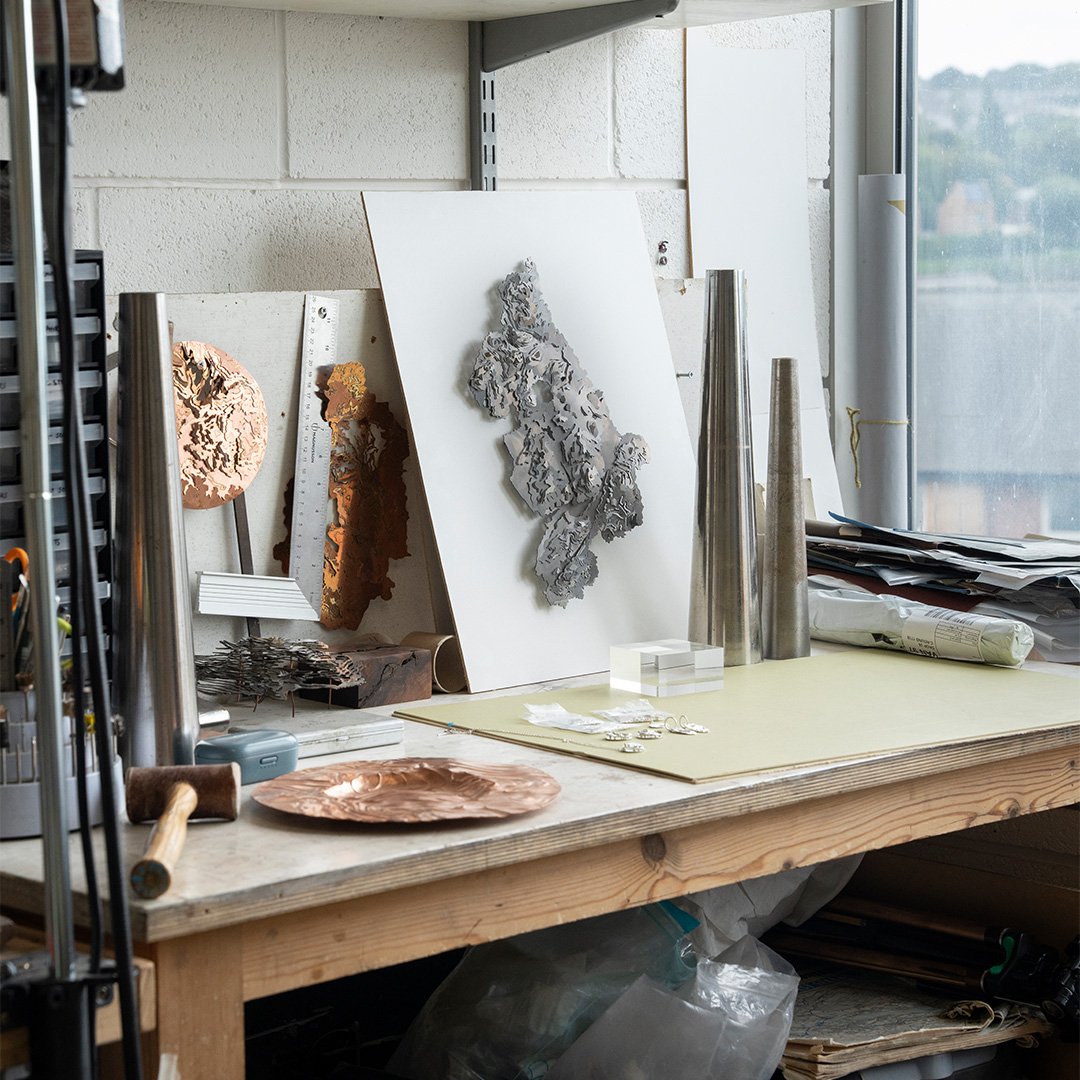
As the maps grew in scale, Holly found herself learning an entirely different set of skills. Her earliest pieces had been traced and cut by hand, but making larger wall pieces meant finding another way to translate the contours of a landscape into metal. Laser cutting offered that possibility, although first Holly had to work out how to create the files needed to do it.
She began teaching herself digital mapping, eventually finding her way to QGIS, a geographic information system that allows her to work with geographical data rather than tracing an existing map. From there, she can extract the information she needs – elevation, waterways and land use – and begin deciding what will become part of the finished piece.
“I taught myself,” she says. It changed what Holly was able to do with the maps. Rather than cutting every contour herself, she could prepare the files and send them to a laser cutter. It keeps the time – and therefore the price – of each piece manageable, while allowing Holly to spend more of that time back at the bench, engraving, forming and bringing the contours to life.
Finding someone to do that cutting was not straightforward. Holly wanted to keep the manufacturing in Sheffield, but despite the city’s metalworking history, finding a company willing and able to take on the work took time. It was another part of learning how to make the maps at the scale she imagined – not necessarily learning to operate the machine herself, but understanding enough of the process to know what she needed from it.
The story of a place
For all the processes that go into making them, the starting point for Holly’s maps remains a place that means something to someone. Often, people see the work before they realise what they are looking at. The layers and lines can be read simply as an abstract pattern, until they discover that what they are seeing is a landscape.
That recognition often leads to another question: what place would they choose? “You can tell a full life story through a map in a really abstract way,” Holly says. As the pieces have grown larger, so too has the amount of that story she can include. A map can hold more than the shape of a landscape; it can become a record of why that particular patch of ground matters to the person it belongs to.
“I think the larger pieces can tell more of a story,” she says. It’s part of what Holly hopes allows them to become heirlooms – objects that carry a connection to a place, and the memories attached to it.
The scale has grown, the processes have changed and the skills Holly uses have multiplied, but what hasn’t disappeared is her desire to keep finding out what else she can do with it. So she continues to learn: “I like the fact that I’m trying to keep some of those skills alive, and that drives me. I’m really excited about that. I do feel really privileged to be able to choose to do this work, and that I’m able to make it work,” she says. “I need to continue to keep pushing in the right direction.”